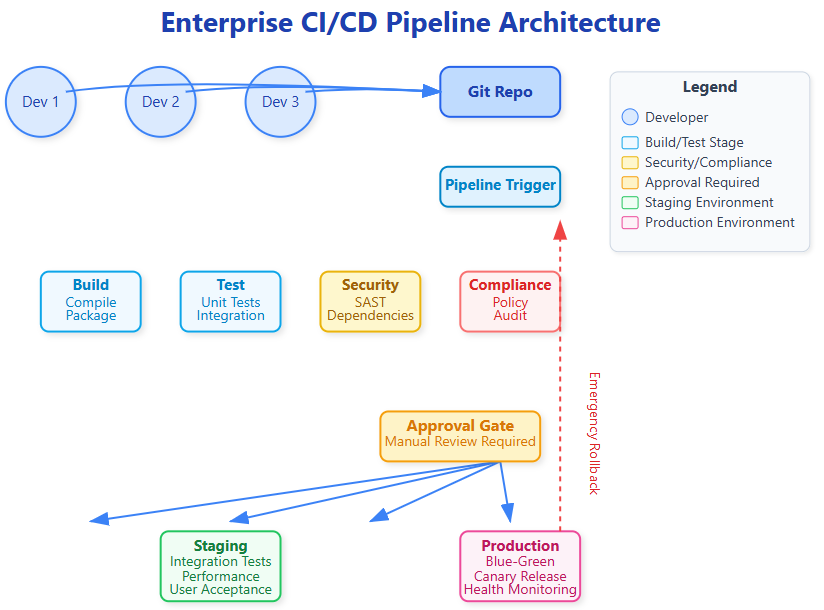
CI/CD Pipeline Architecture for Large Organizations

When Your Pipeline Becomes Your Bottleneck
At Netflix, deploying a single microservice change triggers over 4,000 automated pipeline steps across 127 different services. What started as a simple “push to deploy” workflow evolved into a distributed system more complex than many production applications. This transformation reveals the hidden reality of CI/CD at scale: your deployment pipeline becomes a distributed system with all the complexity that entails.
Today we’ll explore how large organizations architect CI/CD pipelines that handle thousands of developers, deploy hundreds of services, and maintain 99.9% uptime while processing over 50,000 deployments daily.
The Scale Transformation Problem
Traditional CI/CD works beautifully for small teams with linear workflows. But at enterprise scale, three fundamental shifts occur that break conventional approaches:
Parallel Development Chaos: With 500+ developers across 20 time zones, linear merge strategies collapse. Teams need independent deployment paths that can merge safely without blocking each other.
Cross-Service Dependencies: A single user feature spans 15 microservices. Your pipeline must orchestrate deployments across multiple teams while maintaining system-wide consistency.
Compliance and Security Gates: Enterprise pipelines embed approval workflows, security scanning, compliance validation, and rollback mechanisms that transform deployment from minutes to hours.