Designing for Global Payment Systems
The $50 Million Mistake
In 2019, a major fintech company processed the same $1.2 million payment 47 times due to a retry storm during a network partition. Their global payment system lacked proper idempotency guarantees across regions. The incident cost them $50 million in reconciliation, reversed transactions, and regulatory fines. This wasn’t a rare edge case—it’s a fundamental challenge when building payment systems that span continents, currencies, and compliance boundaries.
Global payment systems are deceptively complex. Moving money internationally involves orchestrating distributed databases, handling currency conversions, navigating 200+ regulatory frameworks, and maintaining strict consistency guarantees—all while processing thousands of transactions per second with sub-second latency expectations.
The Core Architecture
Global payment systems solve a fundamental distributed systems problem: achieving strong consistency across geographically distributed data centers while maintaining high availability for a write-heavy, financially critical workload.
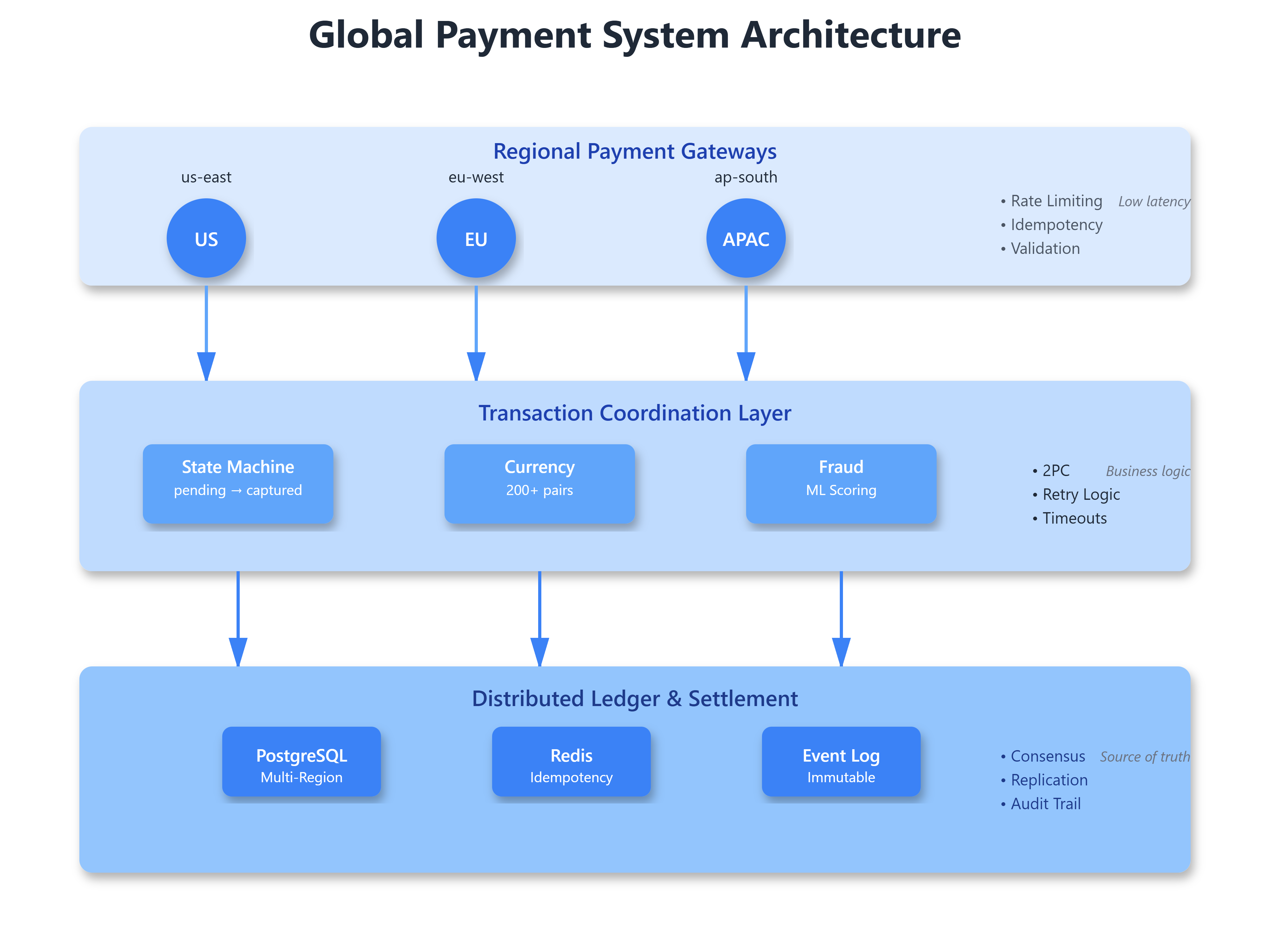
The architecture centers on three critical layers:
Payment Gateway Layer:
Regional entry points that accept payment requests and perform initial validation. Each region runs independent gateway services that route to the nearest payment processor. This geographic distribution reduces latency—a user in Singapore shouldn’t wait for a round trip to Virginia. Gateways handle rate limiting, basic fraud checks, and idempotency key validation before forwarding requests.
Transaction Coordination Layer:
The heart of the system, responsible for the complex dance of debiting accounts, currency conversion, compliance checks, and settlement. This layer implements a distributed state machine where each payment transitions through states: pending → validated → authorized → captured → settled. The state machine isn’t just for tracking—it’s the mechanism that enables safe retries and prevents duplicate charges.
Ledger and Settlement Layer:
Maintains the source of truth across regions using either consensus protocols (Raft/Paxos) or event sourcing with eventual consistency. Modern systems use a hybrid approach: synchronous writes for critical money movement, asynchronous replication for analytics and reporting.