Designing Multi-Region Active-Active Systems
Introduction
When Stripe processed their billionth API call in 2019, every region was simultaneously accepting payments. A datacenter fire in Europe didn’t redirect traffic—it simply stopped receiving its share. Users in London seamlessly connected to Dublin, experiencing only 12ms additional latency instead of complete downtime. This is active-active architecture: not a backup plan, but a fundamental design where all regions operate as equals.
Understanding Active-Active Architecture
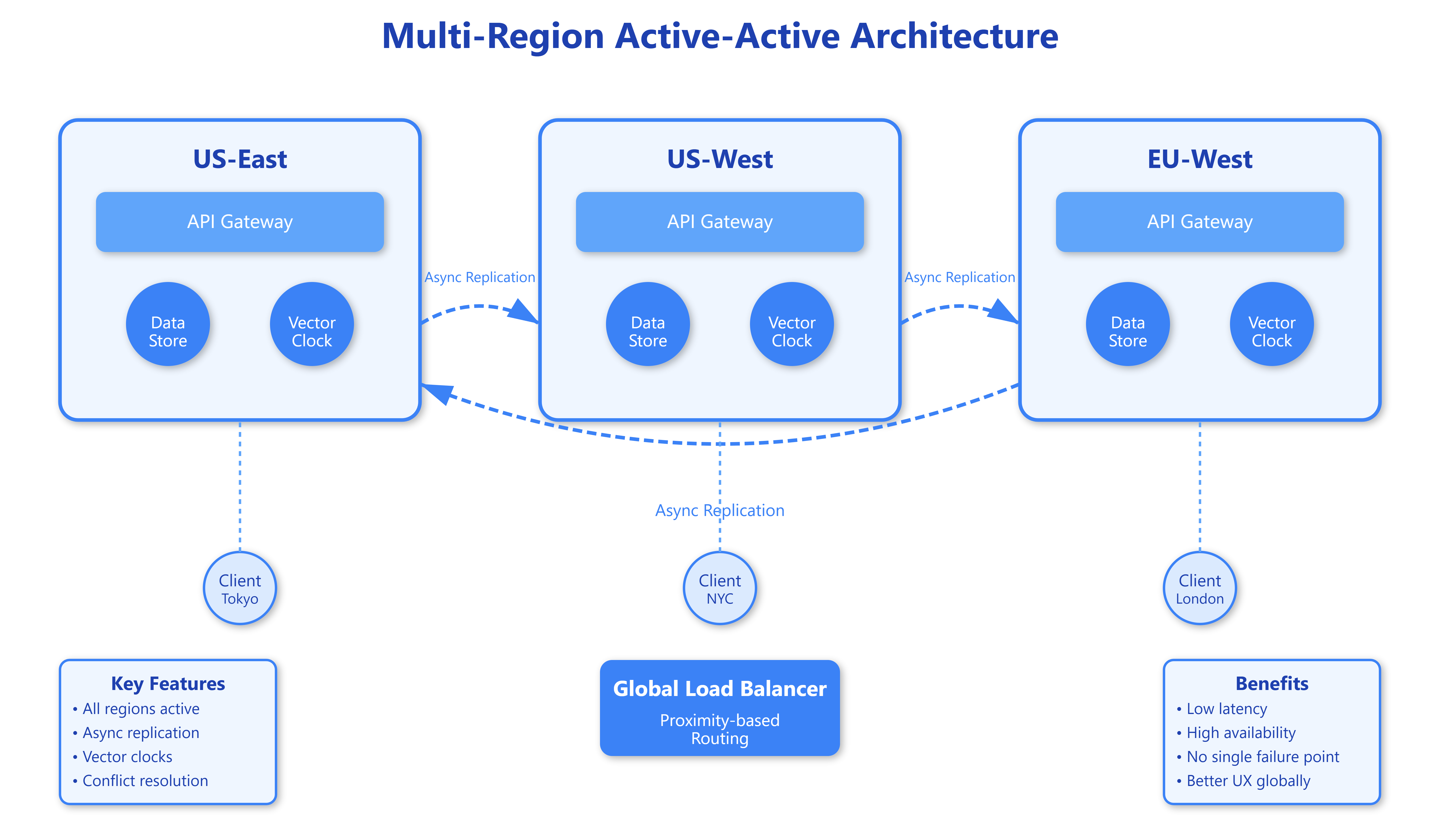
Multi-region active-active systems distribute workload across geographically separated datacenters, with each region fully capable of handling any request. Unlike active-passive setups where secondary regions wait idle for failure, every region actively serves production traffic. This creates three critical challenges: maintaining data consistency across continents, resolving conflicting updates when users modify the same data simultaneously in different regions, and routing traffic intelligently based on proximity and health.
The core mechanism relies on asynchronous replication between regions. When a user in Singapore updates their profile, that write succeeds locally within milliseconds. Behind the scenes, the change propagates to US, Europe, and other regions, typically completing within 100-500ms depending on distance. During this replication window, a user in New York might briefly see stale data—but the system remains available and responsive everywhere.
The non-obvious challenge emerges during concurrent writes. If Alice in Tokyo and Bob in New York both update a shared document at the same instant, which version wins? Traditional databases assume a single authority can serialize operations, but active-active systems lack this luxury. Solutions include last-write-wins (simple but loses data), conflict-free replicated data types (CRDTs that mathematically merge changes), or application-level resolution (letting users choose). Each approach trades consistency guarantees for availability.