Domain-Driven Design in System Architecture
Why Your Microservices Are Probably Wrong
When Netflix rebuilt their monolith into 700+ microservices, they didn’t just split code—they discovered something profound about software boundaries. The services that thrived had clear business purposes, while those that failed were technical constructs that didn’t align with how the business actually worked.
This revelation sits at the heart of Domain-Driven Design (DDD): your system architecture should mirror your business architecture, not your database schema.
Today you’ll learn how DDD transforms chaotic microservices into coherent business capabilities, and build a working system that demonstrates these principles in action.
What We’ll Master Today
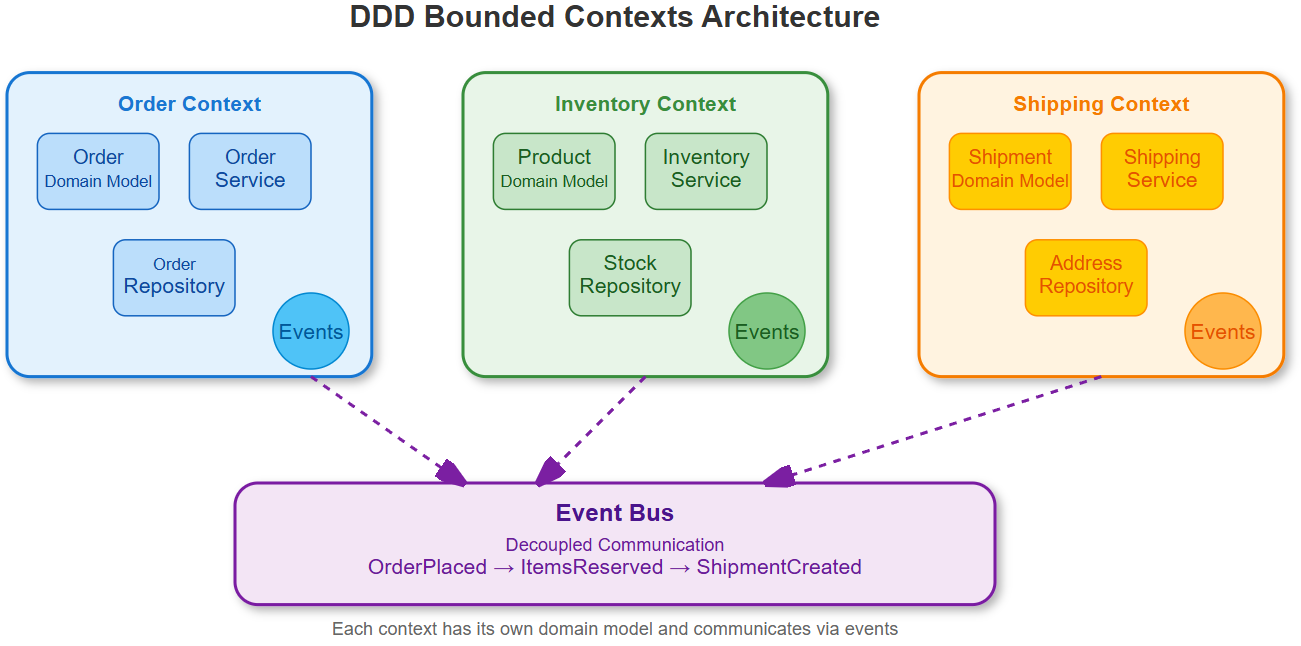
Bounded Contexts: Natural system boundaries that prevent model confusion
Domain Models: Business logic that lives independently of databases
Aggregates: Consistency boundaries that replace distributed transactions
Anti-Corruption Layers: Protection from legacy system complexity
Event-Driven Integration: Loose coupling between business domains
The Mental Model Shift
Traditional system design starts with data structures and builds up. DDD starts with business capabilities and builds down. This isn’t academic theory—it’s how Amazon organizes 25,000+ developers across hundreds of services.