
Server-Side Rendering (SSR) vs. Client-Side Rendering (CSR): Performance Implications
The 3-Second Decision That Cost $40M in Revenue
Your e-commerce homepage takes 3.2 seconds to render on a median mobile device. Users see a blank white screen while 800KB of JavaScript downloads, parses, and executes. By the time your product carousel appears, 53% of users have already left. This isn’t a hypothetical scenario—it’s the reality Amazon quantified: every 100ms of latency costs them 1% in sales. The rendering strategy you choose—server-side or client-side—isn’t just a technical decision. It’s a business-critical architectural choice that determines whether users see content in 200 milliseconds or 3 seconds.
Understanding the Rendering Divide
Server-Side Rendering generates complete HTML on the server before sending it to the browser. When a request arrives, your Node.js server executes React/Vue components, produces fully-formed HTML, and streams it to the client. The browser receives ready-to-display content immediately—no JavaScript execution required for initial paint.
Client-Side Rendering ships a minimal HTML shell with JavaScript bundles. The browser downloads these bundles, parses JavaScript, executes framework code, fetches data via API calls, constructs the DOM, and finally renders content. This multi-step waterfall introduces unavoidable latency.
The performance divergence is dramatic. SSR delivers First Contentful Paint (FCP) in 200-400ms on 4G networks because HTML is immediately renderable. CSR typically hits 2-4 seconds for FCP because it requires the full JavaScript download → parse → execute → render pipeline. Time to Interactive (TTI) tells a different story: SSR requires hydration (attaching event handlers to server-rendered HTML), creating a gap where content is visible but not interactive. CSR achieves interactivity immediately after rendering completes because JavaScript is already loaded and executed.
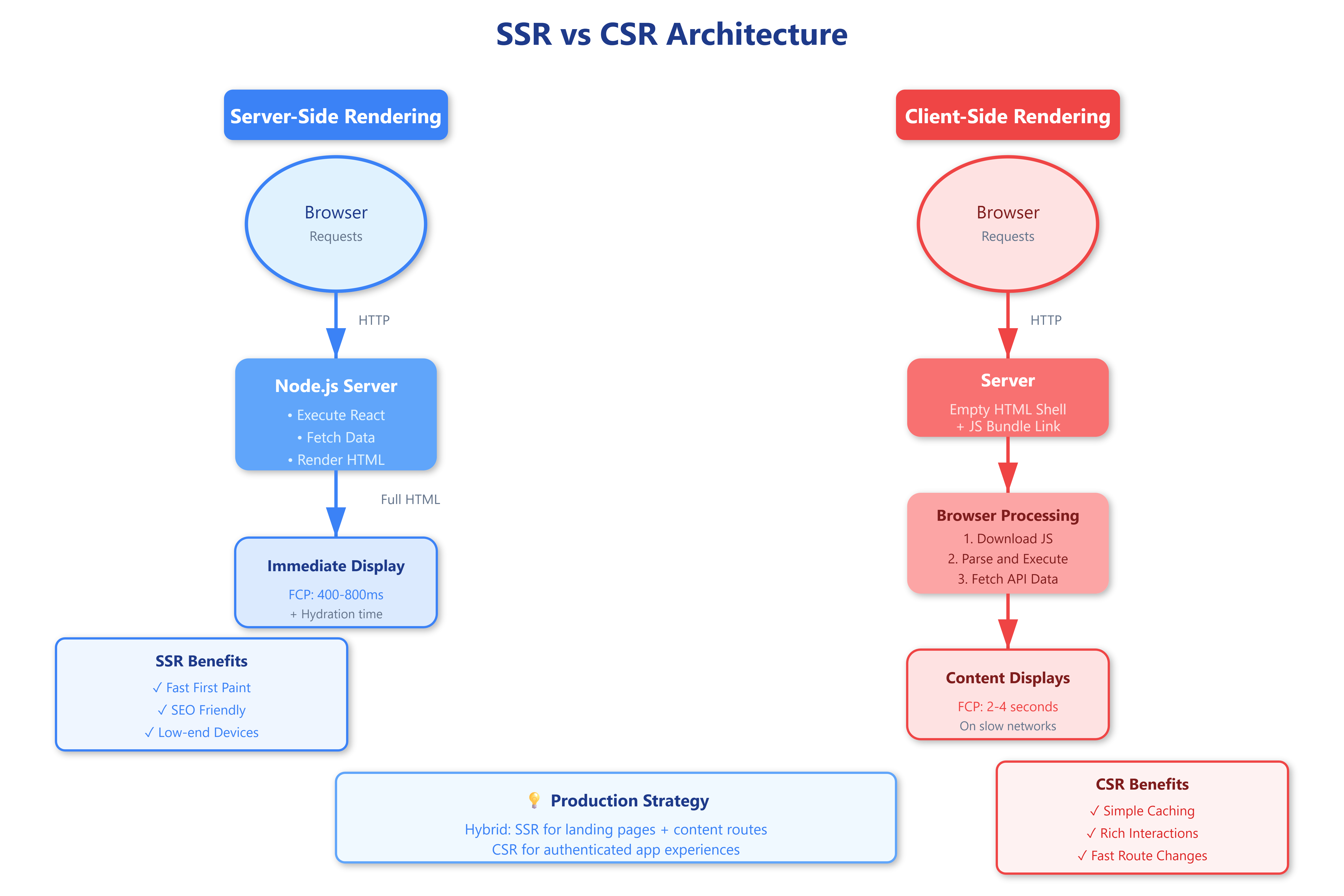
The critical bottleneck isn’t rendering itself—it’s the network and JavaScript execution cost. A 500KB gzipped bundle takes 1.4 seconds to download on a slow 3G connection (1.6 Mbps). Parse and compile time for that bundle consumes 200-400ms on mid-tier mobile devices. SSR eliminates this critical path for initial content visibility.
